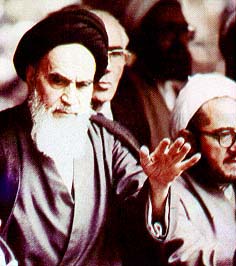
Ayatuollah Ruhollah Khomeini
(1902-1989)
"Ayatullah Ruhollah Khomeini"
by Milton ViorstBrazenly defying the West, he revived Islam's faithful and authored a new form of religious government. The prescriptions were often chilling.
To Westerners, his hooded eyes and severe demeanor, his unkempt gray beard and his black turban and robes conveyed an avenger's wrath. The image is the man.
Ayatullah Ruhollah Khomeini, the dour cleric who led an Islamic revolution in Iran, perceived himself above all as an avenger of the humiliations that the West had for more than a century inflicted on the Muslims of the Middle East.
He was among many Muslim autocrats in this century to embrace a mission designed as a corrective to the West. Kemal Ataturk, the most daring of them, introduced Turkey, after the fall of the Ottoman Empire in World War I, to Western-style secularism in order to toughen his society against Europe's imperial designs. In the 1950s, Egypt's Gamal Abdel Nasser, more intemperately, initiated a fierce campaign of Arab nationalism aimed at eradicating the vestiges of Western colonialism from the Arab world.
Khomeini took a different course. All three, at their apogee, were rulers of once great empires that had fallen into political and social disarray. But Ataturk and Nasser were committed to resurrection by beating the West at its own game of building strong secular states. Khomeini's strategy was to reject Western ways, keeping Iran close to its Islamic roots.
Some ask, focusing on this strategy, whether Khomeini was riding a popular wave in global affairs. In the late 20th century, Muslims were not alone in organizing to restore religious belief to government. Christians in America, Jews in Israel, even Hindus in India were promoting the same end. As a revolutionary, Khomeini sought to bring down not just the Shah's Western-oriented state but also the secular Weltanschauung that stood behind it. Did Khomeini's triumph augur an intellectual shift of global magnitude?
While historians ponder this question, it is enough to say that Khomeini presided brilliantly over the overthrow of a wounded regime. He was merciless and cunning. His well-advertised piety complemented a prodigious skill in grasping and shaping Iran's complex politics. Most important, he knew how to exploit the feelings of nationalist resentment that characterized his time.
Ruhollah Khomeini--his given name means "inspired of God"--was born to a family of Shi'ite scholars in a village near Tehran in 1902. Shi'ism, a minority sect in Islam, is Iran's official religion. Like his father, he moved from theological studies to a career as an Islamic jurist. Throughout his life, he was acclaimed for the depth of his religious learning.
As a young seminary teacher, Khomeini was no activist. From the 1920s to the 1940s, he watched passively as Reza Shah, a monarch who took Ataturk as his model, promoted secularization and narrowed clerical powers. Similarly, Khomeini was detached from the great crisis of the 1950s in which Reza Shah's son Mohammed Reza Pahlavi turned to America to save himself from demonstrators on Tehran's streets who were clamoring for democratic reform.
Khomeini was then the disciple of Iran's pre-eminent cleric, Ayatullah Mohammed Boroujerdi, a defender of the tradition of clerical deference to established power. But in 1962, after Boroujerdi's death, Khomeini revealed his long-hidden wrath and acquired a substantial following as a sharp-tongued antagonist of the Shah's.
Khomeini was clearly at home with populist demagogy. He taunted the Shah for his ties with Israel, warning that the Jews were seeking to take over Iran. He denounced as non-Islamic a bill to grant the vote to women. He called a proposal to permit American servicemen based in Iran to be tried in U.S. military courts "a document for Iran's enslavement." In 1964 he was banished by the Shah to Turkey, then was permitted to relocate in the Shi'ite holy city of An Najaf in Iraq. But the Shah erred in thinking Khomeini would be forgotten. In An Najaf, he received Iranians of every station and sent home tape cassettes of sermons to be peddled in the bazaars. In exile, Khomeini became the acknowledged leader of the opposition.
In An Najaf, Khomeini also shaped a revolutionary doctrine. Shi'ism, historically, demanded of the state only that it keep itself open to clerical guidance. Though relations between clergy and state were often tense, they were rarely belligerent. Khomeini, condemning the Shah's servility to America and his secularism, deviated from accepted tenets to attack the regime's legitimacy, calling for a clerical state, which had no Islamic precedent.
In late 1978 huge street demonstrations calling for the Shah's abdication ignited the government's implosion. Students, the middle class, bazaar merchants, workers, the army--the pillars of society--successively abandoned the regime. The Shah had nowhere to turn for help but to Washington. Yet the more he did, the more isolated he became. In January 1979 he fled to the West. Two weeks later, Khomeini returned home in triumph.
Popularly acclaimed as leader, Khomeini set out to confirm his authority and lay the groundwork for a clerical state. With revolutionary fervor riding high, armed vigilante bands and kangaroo courts made bloody work of the Shah's last partisans. Khomeini canceled an experiment with parliamentarism and ordered an Assembly of Experts to draft an Islamic constitution. Overriding reservations from the Shi'ite hierarchy, the delegates designed a state that Khomeini would command and the clergy would run, enforcing religious law. In November, Khomeini partisans, with anti-American passions still rising, seized the U.S. embassy and held 52 hostages.
Over the remaining decade of his life, Khomeini consolidated his rule. Proving himself as ruthless as the Shah had been, he had thousands killed while stamping out a rebellion of the secular left. He stacked the state bureaucracies with faithful clerics and drenched the schools and the media with his personal doctrines. After purging the military and security services, he rebuilt them to ensure their loyalty to the clerical state.
Khomeini also launched a campaign to "export"--the term was his--the revolution to surrounding Muslim countries. His provocations of Iraq in 1980 helped start a war that lasted eight years, at the cost of a million lives, and that ended only after America intervened to sink several Iranian warships in the Persian Gulf. Iranians asked whether God had revoked his blessing of the revolution. Khomeini described the defeat as "more deadly than taking poison."
To rally his demoralized supporters, he issued the celebrated fatwa condemning to death the writer Salman Rushdie for heresies contained in his novel The Satanic Verses. Though born a Muslim, Rushdie was not a Shi'ite; a British subject, he had no ties to Iran. The fatwa , an audacious claim of authority over Muslims everywhere, was the revolution's ultimate export. Khomeini died a few months later. But the fatwa lived on, a source of bitterness--as he intended it to be--between Iran and the West.
Beside the fatwa , what is Khomeini's legacy? The revolution, no longer at risk, still revels in having repeatedly, with impunity, defied the American Satan. The Islamic state was proof to the faithful--as the Soviet Union was to generations of communists--that the Western system need not be a universal model.
Yet Khomeini rejected a parallel between his doctrines and the fundamentalism propounded by other Muslim dissidents. He never described himself as fundamentalist. He often said that Islam is not for 14 centuries ago in Arabia but for all time.
Since Khomeini's death, the popular appeal of an Islamic state--and of fundamentalism--has surely dimmed. Thinkers still debate and warriors kill, but no country seems prepared to emulate Iran. Perhaps revolutions happen only under majestic leaders, and no one like Khomeini has since appeared.