
Almost 38 years ago I first read and enjoyed Ernest Hemingway’s “For Whom the Bell Tolls.” I read it avidly over a stretch of two or three days in September of 1987. I had just moved into my apartment to start as a student at UCLA. I remember it well.
My oldest daughter herself will start at UCLA next month, and I am reading “For Whom the Bell Tolls” again. But this time I am reading it in Spanish – “Por Quien Doblan Las Campanas,” translated from English into Spanish by Lola de Aguado. I chuckle a little to myself thinking how Hemingway wrote about the Spanish Civil War where everyone presumably was speaking in Spanish but the story is recounted in English. Now I’m having that English-language story translated back into Spanish. Talk about irony! It is like reading a book about the American Civil War set in Virginia with the characters wearing the Confederate gray, and they are all talking in Spanish. Weird. What historical accuracy is lost with all these linguistic gymnastics? I had a Chilean girlfriend once who told me she had read and enjoyed William Shakespeare’s “Romeo and Juliet,” but it was translated into Spanish. There is something lost, and I suspect that “something” is large.
Why am I reading Hemingway’s Spanish Civil War novel translated in Spanish? Well, for several years now I’ve been reading books I enjoyed in English decades ago translated into Spanish, and I’m doing this as an instructional aid to improve my Spanish. I enjoyed these stories in English and remember them reasonably well. So it makes the books easier to understand in a second language (Spanish) when I know the general outlines of the plot. And it ensures I will appreciate and enjoy the story even as I don’t understand 100% of the words. So it was a natural choice to revisit “For Whom the Bell Tolls” – or “Por Quien Doblan Las Campanas” – after almost four decades.
There is a second reason. The Spanish Civil War has been a special topic for my family. My father wrote his senior thesis at Harvard University on that conflict back in 1959. He travelled from Boston to New York City to do original “research” on the topic by interviewing retired U.S. State Department officials who served in Spain at that time. As a history major my father published a long research paper about the Spanish Civil War which is supposedly still in the Harvard Library archives somewhere. Then he took a “Modern European Politics” class at Harvard from Henry Kissinger, the emigre professor who later went on to become famous as the Secretary of State in the Nixon Administration. Professor Kissinger assigned his in class final exam question on the Spanish Civil War, and when my dad saw the prompt he wanted to jump up and down in excitement. How lucky he was! “When Kissinger came back with the graded essays, mine was absolutely on top of the stack with the highest grade!” my father likes to recall with pride. This is a prized memory for my dad, a student who enjoyed academic success through dogged hard work, not natural brilliance. So the Spanish Civil War and “For Whom the Bell Tolls,” along with Fyodor Dosteyevski’s “Crime and Punishment,” hold a special place in the familial literary canon. You had to have read those books.
Almost 40-years later I still remember parts of the novel. I recall Robert Jordan’s brief but passionate love affair with Maria. (“The earth moved.”) I remember the villagers killing the fascists and throwing their bodies off the cliff, and the heartbreaking final few pages which hold the attention tightly. I never forgot Jordan lamenting the mediocre-at-best generals of Republican Spain: “There are a lot of McClellans on our side, but no Jeb Stuarts.” It is strange the specific details that stick with one from a book or a movie decades later.
But it is a wonderful opportunity to encounter a work of art seriously by re-visiting it after the passing of so many years. You can view the book or movie with fresh eyes and gain new and deeper insights, because you are a different person with more experience in the world and an ability to see things you might have missed the first time. What stood out to me both now and then was how embarrassing is the political naivete of protagonist Robert Jordan. Jordan traveled to Spain to fight the fascists and hobnobbed with Soviet military forces and took orders from them – and gave his life in the struggle. Initially, at least, Jordan was a big believer in the proletariat revolution and “people’s struggle.” To his credit, and that of Hemingway, he came to see through the communist bromides in revolutionary Spain. At the time of his death Jordan was much less naive than he was when he joined the fight. But still.
You want to fight against the fascist forces of Francisco Franco – or Mussolini’s Italy or Hitler’s Germany? Absolutely nothing wrong with that.
But you are fighting with Stalin’s Soviet Union and taking orders from the communists? Are you kiddin’ me? There is definitely something wrong with that. George Orwell, also fighting in Spain on the Republican side, came to appreciate this while almost losing his life in the process. Hemingway’s fictional character Robert Jordan fared less well.
It reminds me of an important point in a political conflict, violent or otherwise: It does not only matter who you against. It also matter who you fight for.
Let’s go back to the French Revolution. I would have no complaint with a Frenchman in 1791 who wanted to be a “citizen” of a Republic rather than a “subject” in a Monarchy. But by 1793 the Jacobins had guillotined the Girondists, and it only went downhill from there – well, I could have lived with the monarchy, at least in the short-term, rather than endure the Terror. The road to hell is paved with good intentions taken way too far, and the French Revolutionaries made a bad situation worse. When it finally fell completely apart – when Robespierre himself lost his head at the guillotine, when Napoleon eventually took over – the country sighed with relief. The French Revolution is only a positive force in history if one looks at the long-view – the very long-view. The French are now in their Fifth Republic.
But let’s return to the 20th century history and fuzzy-headed leftism: the political naivete of a “fellow traveler” like Robert Jordan from “For Whom the Bell Tolls.” Jordan was a university Spanish professor before he joined the international communist cause. Many of these Marxists were academics or entertainment types. It is the same now. A question: You joined the dictator Joe Stalin’s forces to fight against those of the dictators Mussolini and Hitler? DO YOU SEE A PROBLEM HERE?
Similar questions in later eras: So you decided to travel to Fidel Castro’s Cuba in 1969 during your summer vacation as an “idealistic” college years to harvest sugar and help build a socialist paradise there? Or travel to North Vietnam in 1972 to support the anti-imperialist effort against the “paper tiger” United States? ARE YOU DUMB AS A ROCK?
Notice I don’t feel the same way about a “politically aware” college student who decided to be a “freedom rider” in the Deep South of 1964, or to help sharecroppers to register to vote in rural Mississippi. I have all the respect in the world for people who chose to do that.
Again, who are you allying yourself with? The Cubans and the North Vietnamese? Or the civil rights activists in the Jim Crow era? There is an enormous difference. It takes the ability to see nuance and exercise good judgement – and to not be used by more cynical actors. Your life, like that of Robert Jordan in the Spanish Civil War, might be on the line.
Or how about in more recent times. I remember film director Oliver Stone and actor Danny Glover waxing rhapsodically about Hugo Sanchez’s left-wing populism in Venezuela circa 2011. Now that the dictatorship of that man has devolved into (a devolution which, for me, seems natural and inevitable) the disaster which is Venezuela today, those two have long gone silent. For many years now Venezuela has been a miserable, failed state – with millions of refugees fleeing the country to the rest of Latin American and the United States, creating untold problems. It should all have been totally foreseeable. Just like in Cuba and Nicaragua. Left-wing revolutions in those countries degenerated into miserable dictatorships, too. But the promise of a “people’s revolution” initially looked good to a particular kind of romantic American leftist, like Robert Jordan, the college professor. But the secular religion of leftist wealth distribution by the sword has almost always failed. After so many failures one wonders why anyone believes in it at all?
“True believers” in left wing struggle on behalf of “the people” will observe wryly that by the time of his death Robert Jordan had become “cynical” – that he had started to disbelieve in the righteousness of the Revolution. He had come to doubt the Cause of Communism as practiced in the Spanish Civil War. This political skepticism makes Jordan following the orders of Joseph Stalin and the Soviet Union in “Republican Spain” more palatable, especially in retrospect, in my opinion. It makes Jordan’s life and death merely tragic, rather than evil.
Back in 1987 I felt this way about Robert Jordan and “For Whom the Bell Tolls,” and I feel so even more now after decades of studying and teaching history. Again, the road to hell is paved with good intention, and revolutionaries travel it often from the French, Russian, Chinese, Cuban revolutions onward. Being politically idealistic and allowing oneself to be exploited by nefarious elements is worse than being cautious and careful in your ideas about political change; that is almost a core belief for me. It is not enough to have a big heart and want the world to improve. Your “feelings” are not enough. You have to be smart about it – appreciate nuance, have good judgement. Show some patience and common sense. You have to use your brains as much, or more so, than your heart. Deploying a skeptical realism with respect to human nature and political change would be helpful, rather than a naivete that makes things worse. You might have issues about how the Israelis have handled the Gaza War since December of 2023. I do, too. But that leads you to become a supporter of Hamas, Hezbollah, or Iran? Really?!? There are some conflicts in which there are no good guys. No heroes. Just cruelty, violence, and suffering. Recognize this. The Spanish Civil War was one of those conflicts.
Vladimir Lenin allegedly once called Western sympathizers to his Bolshevik cause as “useful idiots.” These were Western intellectuals, writers, entertainers, or activists who were sympathetic to communism (or Soviet causes) and who, in the eyes of Soviet leaders, could be manipulated to serve their goals without fully understanding the reality of the regime. They could be manipulated into saying almost anything to help “the cause.” That was well said. Robert Jordan was a “useful idiot.” He died for it. No memorial will ever be built for him. His family in the United States will have mixed feelings, at best, about his life choices. There might even be a dossier about him in the FBI archives under “suspected communist.” That’s because he was one. So these conclusions color everything else for me about Robert Jordan in the book “For Whom the Bell Tolls.” There are deep lessons there. I saw them when I first read the novel back in 1987, and they are only more deeply realized as I read it again today.
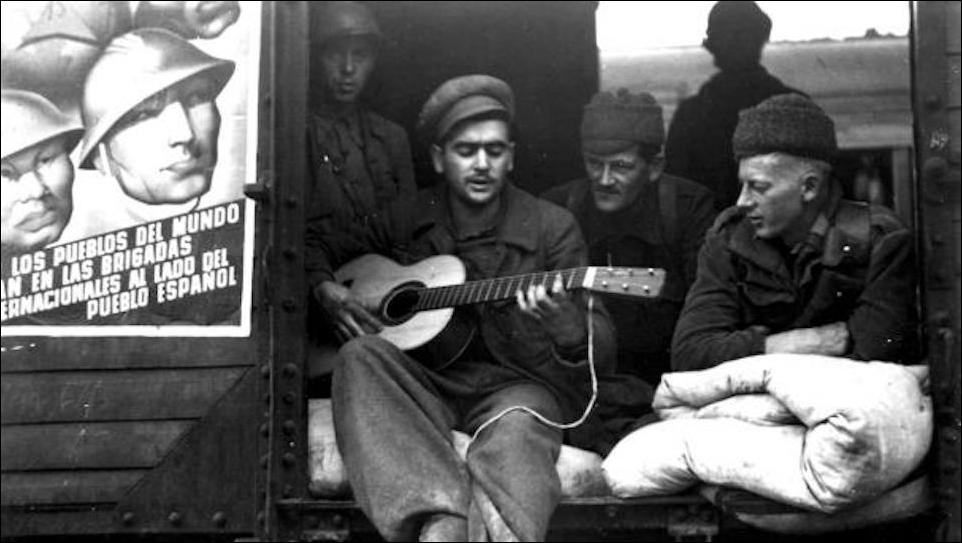
So we return again to those uncomfortable questions. You traveled to Spain in 1937 to fight with the Abraham Lincoln Brigade? Harvested sugar cane in Castro’s Cuba in 1969 as a college student during your summer vacation? Traveled to North Vietnam with Jane Fonda in 1972? Romanticized the Khmer Rouge taking power in Cambodia in 1975 and hoped they would cleanse the country of Western bourgeois influences? Gave support to the Nicaraguan Sandinistas in 1979? Were a huge believer in Hugo Chavez in Venezuela of 2012? Carried a pro-Hamas message on the placard you carried in a campus protest in 2024?
If so, I will always squint and regard you as if you had three heads on your shoulders. As if you were a special kind of highly-educated dumb person – a “revolutionary leftist.” And so will most other people.
R.I.P. to Robert Jordan. One step forward for choosing to fight against Mussolini and Hitler before it became fashionable. But one step backwards, and maybe more, for volunteering to travel to a country not your own and aligning yourself with Stalin’s Soviet Union — in the end, dying for nothing. Franco and the “nationalist” forces in Spain won that civil war and ruled the country until 1975. Jordan’s sacrifice made no difference.
But if you had waited a few more years, Robert, you could have fought against Mussolini and Hitler under the flag of your own country during WWII. Or you could have struggled against Stalin and his ilk later during the Cold War. That would have been the way to go. But no.
Nuance. Good judgement. Common sense. Patience. Skepticism. An appreciation of the limits of political change. An understanding that the road to hell is paved with good intentions. Using your brains, as much as your heart.
You were in over your head in Spain, Robert Jordan.
And you paid the price.





2 Comments
Jay Canini
One unfortunate thing is that the Communists intentionally handicapped other leftist groups in the Spanish civil war, so they would be the only one remaining. Homage to Catalonia, by Orwell, discusses this. I’d have to read up on the inter-party struggle, but the leftists purging each other made it easy for the right wing to win.
Speaking of what one is fighting for being important: There have been criticisms of the mainstream politicians of the US Democratic Party (very centrist, and dare I say, conservative – see “The Democrats Are Now America’s Conservative Party”, The Atlantic, 2023) not giving something exciting to people, nothing to really vote for other than opposing Trump. Unfortunately there were a lot of disaffected people in 2024, and this was a factor in Trump winning, as they felt that mainstream politicians like Kamala Harris didn’t give them something to vote for (yes, she has policy proposals, but people didn’t read them). Compare that to upstarts like Mamdani: he gives the feeling that he’s giving something to vote *for*, and this is why his support skyrocketed in NYC.
AOC found that, yes, there were people who voted for both her and Trump on the same ticket, and she asked them – no judgment – why. These voters saw her and Trump as being “authentic”, and the voters were dissatisfied with the status quo. Several people who voted for Trump in 2024 then voted for Mamadani in 2025.
As for the people partying with Cubans/North Vietnamese, it really reminds me of Russell Bentley, the Donbass Cowboy, who read his Che Guevara, consumed pro-Putin propaganda, went to Russian-occupied Ukraine, and then became a propagandist. He was such a “Communist” that he didn’t see he was supporting a cynical right wing government, and Putin and his buddies happily used him as a useful idiot. Bentley was murdered by Russian soldiers. The end.
I also think about the “pro-Palestine” crowd being turned away from the Democratic Party, being told to oppose Biden/Harris, and that facilitated Trump. Many of the “pro-Palestine” crowd was pro-LGBT/workers rights/unions, and Trump of course isn’t. I think that is an example of the “pro-Palestine” groups being used as “useful idiots”. (Yes, I see paragraphs 2 and 5 being true at the same time, sadly).
Ashwin Rebbapragada
I really enjoyed this post. Thank you for discussing the Spanish Civil War and For Whom the Bell Tolls. I am now curious and eager to read about those subjects. I agree we must be careful with the impact and implications of our political beliefs. A very thoughtful and insightful post.