My wife and I have been saving since literally almost her birth to pay for our daughter’s college tuition. Year after year we put money in her 529 investment account for college. Each month we would put at least a few hundred dollars into it. The money added up.
Then in November of 2025 – some 17 years after we created it – we took action to take money OUT of the college savings, not put money INTO it. That was a change. I created an account on their website and directed them to mail me a check. The money would flow in the opposite direction, right when we needed it. I received the check and deposited it.
All those years of saving help. It appears we will be able to give our daughter the gift of a UCLA education without her having to take out crippling student loans. That is the end result. What made that possible? This: having directed a substantial part of our family wealth then and now towards that goal.
Was the investment worth it in the past? Is it worth it today? Will it be worth it moving forward?
To be more specific: Does the investment of money to fund a college education result in a financial payoff upon graduation? Will a person have a better life because of it?
That is a complicated question. It depends on where you went to school, what you study while there, and the type of person you are. What kind of student is this? Is she a go-getter? Does she have momentum, direction, and passion in her studies? Or is it totally the opposite? Is she barely graduating from a mediocre or worse college?
The zeitgeist seems to have moved against a college education in the United States. I read this sentence in the Sunday newspaper from a month ago –“The share of Americans who believe a college degree pays off has fallen by 20 percentage points since 2013.” Wow. The price of a university education has increased exponentially over the past four decades, even adjusted for inflation. The financial rewards, although still substantial, appear less than they used to be. I was so shocked by the Wall Street Journal editorial of December 12, 2025 that I took a picture of the article from with my cellphone after I read it so I could remember:
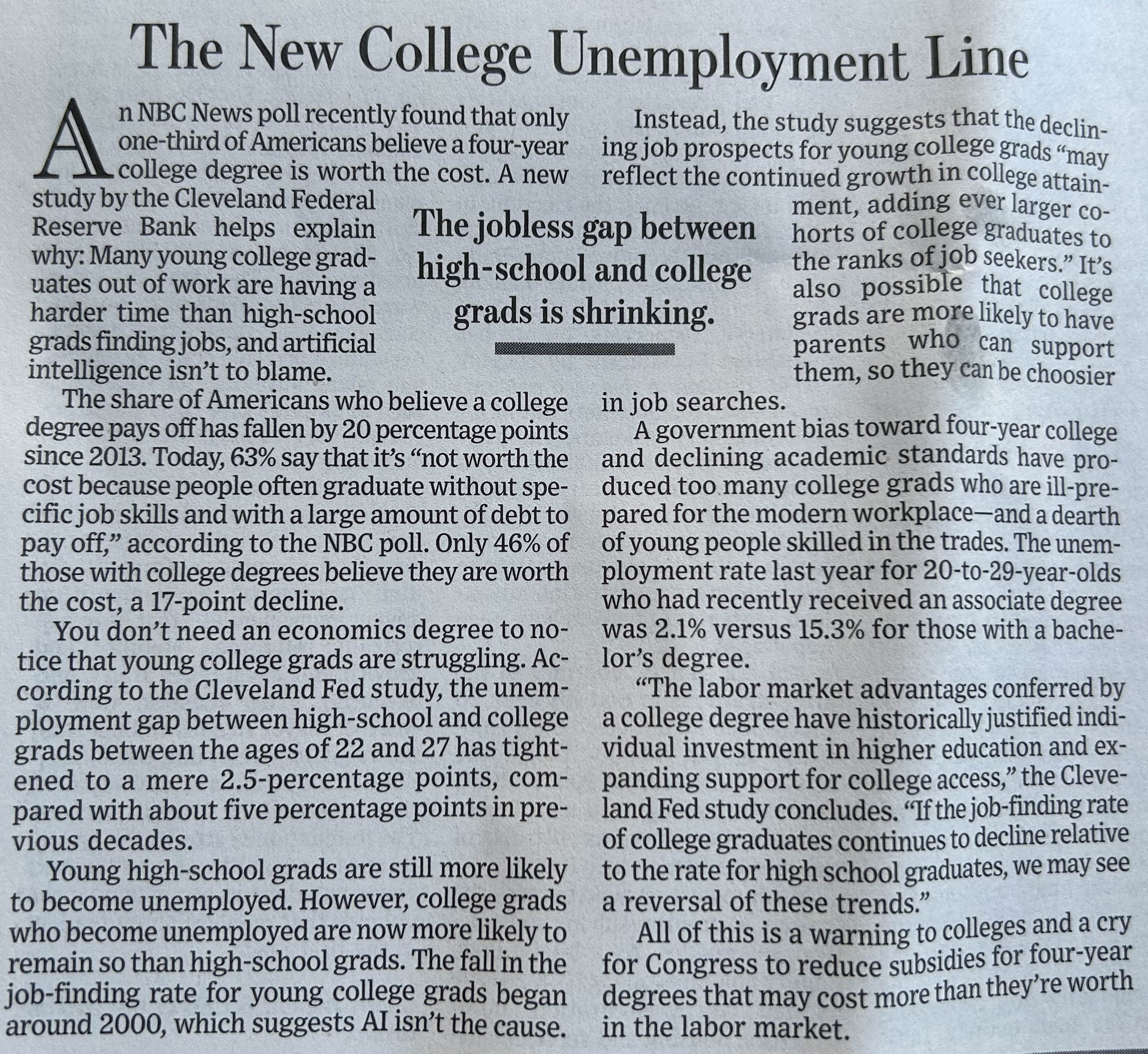
The editorial starts off, “An NBC News poll recently found that only one-third of Americans believe a four-year college degree is worth the cost.” I am unmoved. I suspect two-thirds of Americans are wrong, or mostly wrong, in this. I disagree that a college degree is not worth the money, at least in the case of myself and my family. The point of this essay is to explain my thinking.
I have no apologies for encouraging her to attend and paying for my daughter’s college education. Quite the opposite.
First of all, there is the financial payoff. I have friends whose kids are not going to college, and their parents are not straining like I am to pay for it. I am a little jealous. I’m sweating to pay and they aren’t. Their kids usually are not going to college because they have a learning disability, mental health issues, and/or drug problems. If my kids are going to college in an uncertain world of work afterwards, their kids will be in a much more precarious position with neither job training nor formal education. My daughters with a college education might struggle to integrate into the workforce, but their kids will have absolutely no guarantee for future employment. That is a risky place to be. If I am paying through the nose for college now, will it pay off later for my daughters? I suspect so.
I spent some time on campus at UCLA yesterday and then watched the Bruins beat the Maryland Terrapins 67-55 in basketball at Pauley Pavillion with my daughter –
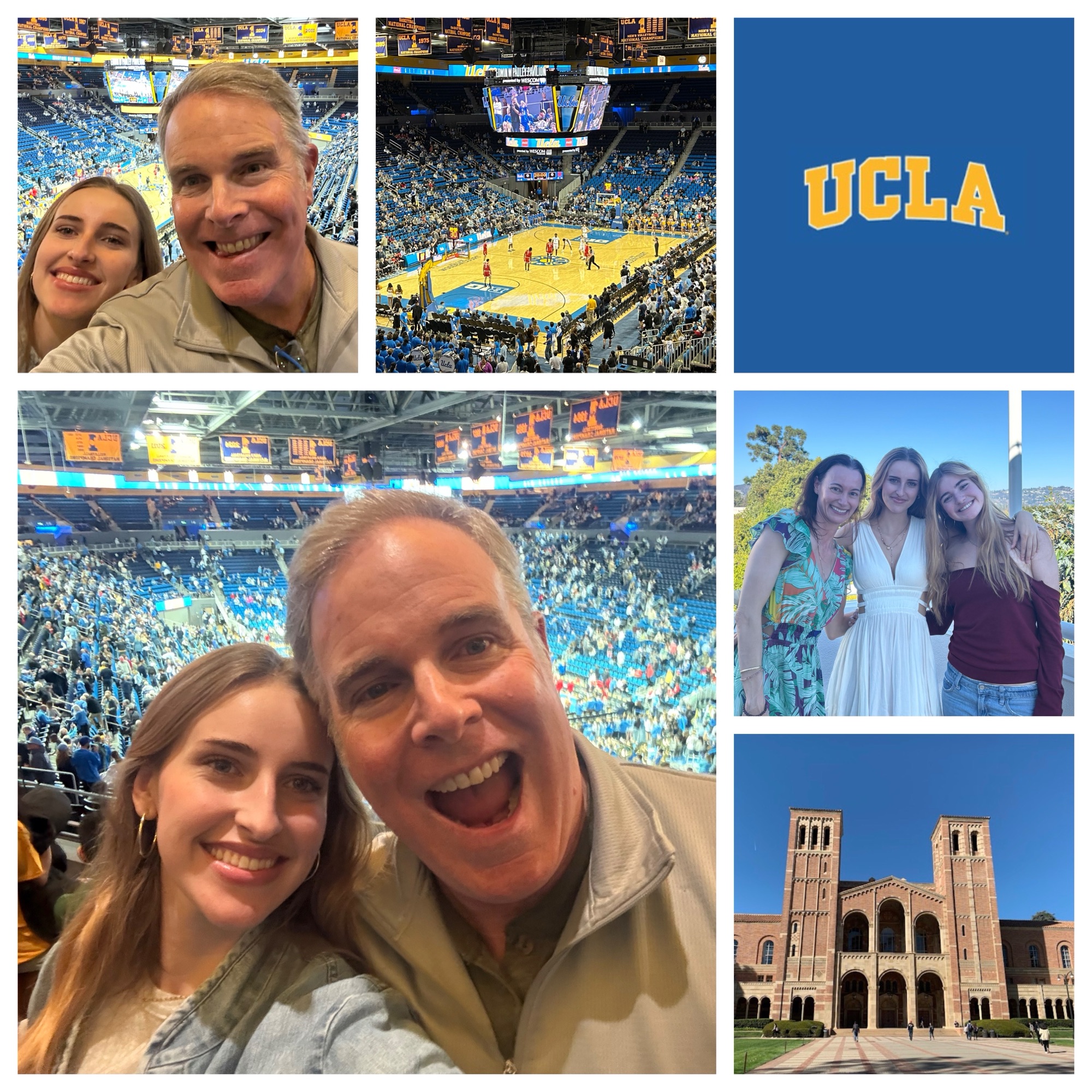
– and the undergraduates I came across there all that day exuded confidence, competence, and potential. You want to tell me these college kids – many of them the best students in their high school class – are not on the fast-track towards success in life? Really?!? College graduates on average have much lower rates of unemployment and higher incomes than non-college grads in America. It might be a precarious world where many struggle (college graduates included) to make ends meet in the capitalist supply-and-demand markets, but it is the poorly educated who struggle most of all. I suspect UCLA alums will do just fine, or better. In part that will be because they were outstanding to begin with, and also because they took advantage of the opportunities UCLA had to offer. That is not worth the tuition?
Let me be clear: a kid who leaves high school and becomes an apprentice welder or plumber, and who likes that job, has all my respect. Those are honorable and necessary jobs, and they pay decent if not outstanding wages. “The trades” can be hard on the body over decades, but it is honest work. Not everybody should go to college. Some like working with their hands. They hate sitting at a desk at school. Fine. It seems so basic one should not have to say it out loud.
But how many young people who don’t go to college never land a solid job with marketable skills. I have met young people who tell me they are all about “hustle culture” – they do part-time dog walking, Uber driving, Internet drop shipping, Amazon delivery, etc. They are scrambling to try and hobble together a living with more active scheming, less formal training. Then they often end up working at Auto Zone or Safeway as a checker, or a fumigator for Orkin, or a bartender at Oliver Garden, or as a receptionist somewhere. Those can be mediocre jobs, depending on the situation and employer, with serious shortcomings as a lifetime career. They qualify more as a “job” than a “career,” and you can be laid off or replaced easily. Job protections are weak; you become an “at will employee.” You are there for years, and then a new boss suddenly shows up and YOU ARE OUT. But you are not trained or qualified for anything much better. You become a member of the “working class,” in the best case scenario (let’s not talk about the worst). There is nothing necessarily wrong with that.
But I want better for my daughters. We have a plan. We have a roadmap. There is money available and opportunity to rise. There is forward momentum and clarity of purpose.
Then there is this: There are plenty of “talking heads” online making a living as pundits who urge young people not to go to college, and their voices are increasingly influential in the national debate, as is evidenced by the fact cited in the WSJ editorial that supposedly two-thirds of America think a college education unworthy of the cost. But also this: Most parents who have a share of education and affluence themselves aren’t urging their kids to enroll in an auto repair training program. They might urge others to be skeptical about college, but they are 100% for their own children going to college. Take note.
It is not easy. A parent whose child is looking at college must be a savvy consumer. There are thousands of universities in the United States offering very different educations in very different places with very different price points and very different outcomes. One must maneuver this maze with patience and skill as a knowledgeable customer. “What are you getting for your money?” The answer to this question will require research and discernment.
That being said, there are still bargains to be had out there. A solid education – both inside and outside the classroom – is an essential catalyst for a successful life. By “education,” I mean not only what is learned from books, but also what is gained through real-world experience. I am speaking of everything that can be learned about the “good life”: the skills that make a living possible, and the deeper lessons that make life worth living. This includes all the important curricula which lead directly to earning money, as well as other equally vital lessons to be learned which have nothing to do with money. I am talking about the “whole person.” I want my daughters to have that space to mature and develop in college, inside the classroom and out. Not an adult, not a worker yet.. but a developing college student. College can be the moment where a young person can begin to move out of the family household for the first time into a dorm with others in the same situation. The college student can encounter new experiences, meet people from different backgrounds, read widely and think deeply, fall in and out of love, and grow up more fully in the process. The amount of learning a person experiences between 18 and 22 should be immense. College for me was that way: a magical time of experimentation and growth, both personally and academically, albeit mixed with incredible highs but also super lows. I earned an education, in the fullest sense of the word. I grew up. I myself attended UCLA, almost 40 years ago. It was a complicated time and not without missteps, but it helped to form me for the rest of my life. It was well worth it.
My wife and I want the same for our offspring and are willing to pay for it. Our daughters can be worker bees for the next four decades after college. But not yet. The idea that one of my daughters would graduate from high school and go lay floor tile as a laborer in “the trades” for the rest of her life in the same town she grew up in is depressing beyond belief. Travel, education: that is what she wants. Work can come later. And work will be hugely influenced and enriched by all the previous travel and education. Work worthy of the name will have been enabled by it.
The idea that my daughters might forgo a college education to do…. something else?
I am open to the idea if my daughters had their heart set on becoming an electrician or enlisting in the military rather than go to college. Or do whatever else, outside of a formal educational setting.
But my daughters taking their education to the next level in college at a reasonable cost where the benefits gained can be enormous is obvious, methinks. They have so far agreed. My older daughter eagerly looked forward to going to college. Getting into a prestigious school like UCLA was the reward for her having worked so hard in high school. My younger daughter looks to follow in her footsteps, or something similar.
The price tag? Tuition over four years?
Around $135,000.
My wife and I are both public school teachers and so are far from wealthy. But we can handle that amount, having saved for it, having current paychecks, and living frugally. We can make it work, albeit with financial pain.
That is a good investment, methinks. My wife and I are happy to pay: short-term pain, long-term gain. “Hard classes, big benefits.”
Or if we aren’t “happy” to pay, we are willing to pay.
Our daughters are high-achieving honors students in a high-achieving high school with significant forward momentum. They generally like school. They are going places. Our daughters have high GPAs and tons of extracurriculars. They don’t mess around with drugs. They are loved and supported at home.
Your kids?
Where will they be in ten years? Twenty? Thirty?
Maybe the question is less specifically “should you go to college or not?”, and more generally “are your kids thriving or not?”
Are your kids actively engaging the world and seeking to find their successful place in it? Are they progressing? Or are they passively drifting from this place to that, without much of a plan or purpose? Stagnating? Or worse?
Will the former take you to one sort of place? And the latter to another very different one?
So take that, Wall Street Journal!
P.S. Everything, including a college education, has an unacceptable price point. 135k for UCLA is worth it. 400k for a private school is not worth it. At least for my wife and I. Ymmv.