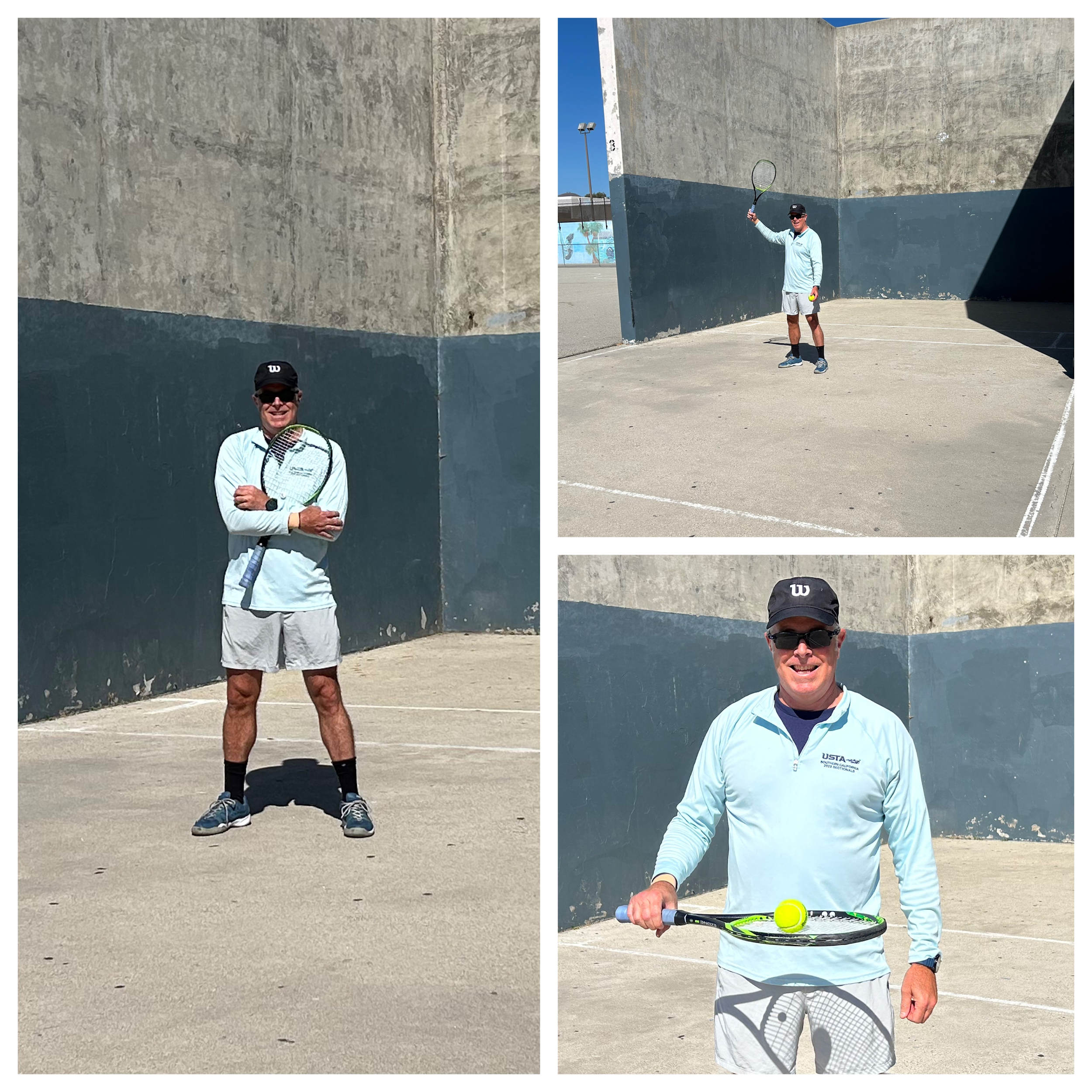
It is my quiet place. It is where I can be by myself, get my pulse rate up, and earn a light sweat. It is where I can get my hands and feet moving in unison with the yellow ball.
It is the wall at Buena High School.
I have been going there for some 14 years once or twice a week. I am almost always alone. I just go there and hit the tennis ball against the wall. The wall never misses, the ball always comes back, and so I hit it again and again and again. It is great practice. The former tennis pro and noted coach Brad Gilbert, among many others, says when he was a child in Piedmont, California he would hit tennis balls against a wall for thousands of hours. He claimed it helped him to become the professional tennis player he eventually became. Here is Roger Federer hitting against a wall:
It is great practice.
But it can also be a bit boring. Which is why none of the many tennis players I know personally hit against the wall like I do.
But I like that it is “boring.” It is a quiet time by myself. The heart rate gets going and I have to focus on moving my feet and hitting the ball cleanly. It focuses the mind.
“Fundamentals, fundamentals, fundamentals!”
I often move almost in semi-slow motion. I concentrate on my footwork and hitting the ball cleanly. I hit my groundstrokes, practice slice shots on both wings, and then I will come close and hit volleys the way a boxer works a speed bag:
This is almost my secret weapon to my tennis game: getting the timing and feel down perfectly, or as perfectly as I can, by hitting against the wall at Buena High School. In the above video I am not trying to go 100%; I want 65% or 75% with correct form, and then I can go faster when I need to in competition. I want to hone the fundamentals today, so I can perform at the highest level possible in a real match tomorrow. When I hit a properly placed volley right in the corner of the tennis court, placed exactly where I want it, I think back about how I got the touch down perfectly hitting against the wall the day before. The technique has to be almost perfect. The technicals of tennis become perfect through practice – endless practice. Tennis is all about footwork and making sure you hit the ball in the center of the racquet, or as close as you can come to it. So I practice doing that again and again. At 58-years of age I don’t think I have hit the perfect volley yet. But I am working towards it still.
I am no Roger Federer, as comparing his YouTube video with mine amply shows. But I have been playing tennis for longer than Federer has been alive. I have been trying to hit the tennis ball properly since approximately the early 1970s. I am still working towards improvement. It is a work in progress, as is so much else. I believe one should aim to play tennis as an adult with the same seriousness and enthusiasm one played tennis with as a child, and I am pursuing that. It has been the work of an entire lifetime. I never stop trying to improve, and the process of trying to improve is where all real progress is earned. And usually, for me, at my age, improvement starts with returning to the fundamentals and proper technique.
“Slow is smooth, smooth is fast, and fast is deadly.”
A firearms instructor once told me about the famed Italian fencing master Fiore dei Liberi back in the 15th century. When Liberi warmed up before a duel, he focused so intently on grip and footwork that his movements seemed absurdly slow—slow enough to make onlookers laugh. But when the moment came to fight for his life, the slowness vanished. Liberi moved with speed, precision, and deadly efficiency. Fiore dei Liberi was counted among the finest swordsmen of his age. Because if you cannot perform an action perfectly at slow speed, there is no chance you can do it at high speed. But if you have achieved mastery with a technique in slow-motion, it becomes possible to do it rapidly.
So I hit tennis balls and recommit to the fundamentals of my tennis strokes. I get “grooved.” I seek for automaticity with my “muscle memory.” Of course, your muscles don’t have memory, but your brain and nervous system do. The muscles (re. nerves) are myelinated and perform as per training. Performing actions over and over again in training are the key to making movements, even complicated movements, second nature. It is how the body learns to move well and to improve neuromuscular coordination. This is how one gains skill on the tennis court: the fundamentals. If a person can play quality tennis with solid technique during a match and thereby make relatively few unforced errors, they most likely will win. It is often that simple.
Young people love to get on the court and bang tennis balls back and forth as fast and hard as they can. People watch them do this and say, “Wow! Those guys are hitting really big strokes! Impressive!” In contrast, I would prefer to hit against the wall and focus on hitting the ball cleanly at slow motion. Over and over again I want the correct footwork and to hit the ball exactly in the center of the strings. The fundamentals. This is my secret weapon. Almost for sure I will be at the wall the day before a big tennis match. I will be hitting the ball faster and harder then.
It is the same with me for marksmanship. I will dry-fire an unloaded gun after drawing it from the holster. I will start off at ultra-slow speed with 100% concentration on the movements of my body. “Bend slightly forward and grab my shirt with my left hand and lift it, grab the firearm with my right hand and lift it out of the holster, immediately flip it forward, raise the gun up and get both both hands on it, and point towards the target while getting a flash sigh-picture and squeeze the trigger at full extension.”
Slow is smooth, smooth is fast, and fast is deadly.
Other reminders:
“Don’t just stand there, Richard. Get off the x. Pull your firearm from the holster – get out of the line of fire, move left or right – and end the threat.”
“Move the gun up from the holster and point it out, move it up to eye level, then push the gun out with both hands while firing at your target. First up, then out – like an elevator.”
“Squeeze the gun with both hands while holding it as firmly as you can, pulling the trigger back without disturbing the sight picture.”
“Keep BOTH EYES open while looking down towards your iron sights.”
All these admonitions from firearms instructors over the years, and more, run through my head as I do my dry fire exercise. I start out slowly, and then I move faster. I try to focus on the fundamentals, the basics. Do it right slowly, so you can then do it fast. Focus on proper technique.
Recreational tennis is not so different from combat marksmanship: one has to build on solid basics of technique, and one has to practice consistently. Your brain will know how to move your body when the time to act has arrived, as long as you remain rooted in the fundamentals – if you refresh and reinforce the neural pathways for correct movement. Both tennis and shooting are perishable skills. They have to be practiced consistently, or at least semi-consistently, for maximum performance under pressure.
But back to the Wall.
Tennis can be difficult because you need others to play with you. That means you need to find one other person in singles, and three others in doubles; that takes some scheduling. But I can go hit against the Wall whenever I want, no scheduling needed. It is just me. Since I always carry my tennis gear in the back of my car, I make extemporaneous trips to the Wall often. It is easy.
I even have locations picked out away from Ventura County. There is a wall near University Park Elementary School in Irvine which I have used often for years. Another one I use less often are the handball courts at San Miguel Park in Newport Beach. Another at Del Obispo Park in Dana Point I have used two or three times. Even away from home I know where to go.
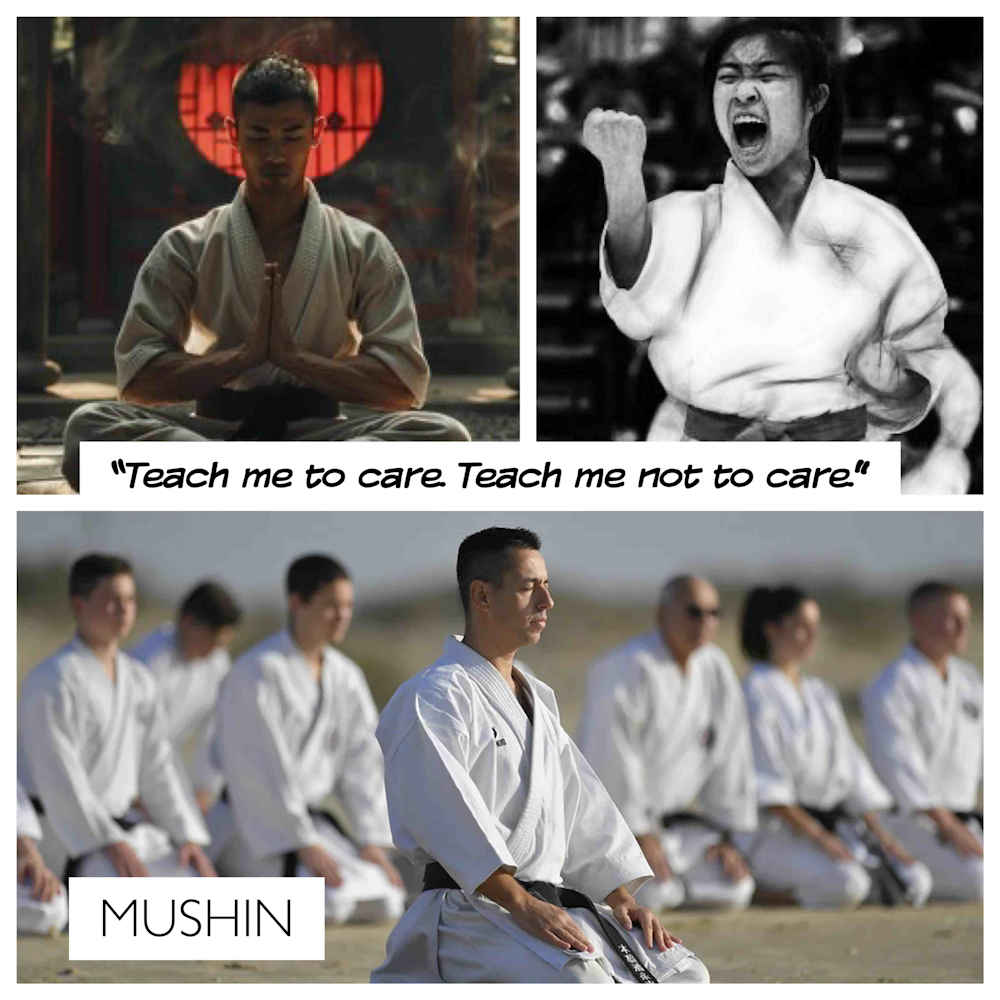
My ritual is always the same: I hit tennis balls against the wall, over and over again, and I sweat mildly while moving my feet and arms – that is what it looks like on the outside. But there is also what is happening on the inside: through movement I try to get in touch with my body and brain. I clear my mind and perform a sort of moving meditation. I ground my body in action and banish the extraneous noise in my mind through concentration. My breathing becomes steady and rhythmic. It is not so different from all the martial arts kata I did when I was younger. Movement. Focus. Calm. Body and mind working together. Everything else more advanced scales up from those basic building blocks.
Fundamentals, fundamentals, fundamentals!
And then move to advanced techniques after that.
I once read of a Green Beret who would run CQB courses where he would show up to the shooting range three hours early to dry fire and work up to the peak state where he would be ready to demonstrate proper technique and teach students. That is professionalism. A Marine Corps Drill Instructor told me he would spend an entire week on the gun safety, marksmanship theory, and dry fire practice before his recruits would fire a single live round. Wow! That is taking the fundamentals seriously. It might prove mighty tedious, but he is not cutting corners on the basics. Lessons so thoroughly and laboriously taught are more likely to stick, I suspect.
Repetition, repetition, repetition!
Amateurs often want to move to advanced techniques quickly, because that is what is fun and sexy. The professionals do not rush things. If you can’t perform the basics perfectly in slow motion, for sure you won’t be able to do them quickly. And advanced techniques almost for sure will be beyond your reach. First things first.
“Slow is smooth, smooth is fast, and fast is deadly.”
And when you can perform basic movements smoothly after ten thousand repetitions over ten years, if you need to do it for real you will be surprised how skillfully and quickly you can move. You will be able to operate decisively and with precision when it counts. And higher-level practices will be well within your reach.
So that is my tennis secret: the handball courts at Buena High School.
I used to bring my daughters to hit with me there they would do whatever I proposed. Here is a photo my older daughter at the Wall back when she was little kid:
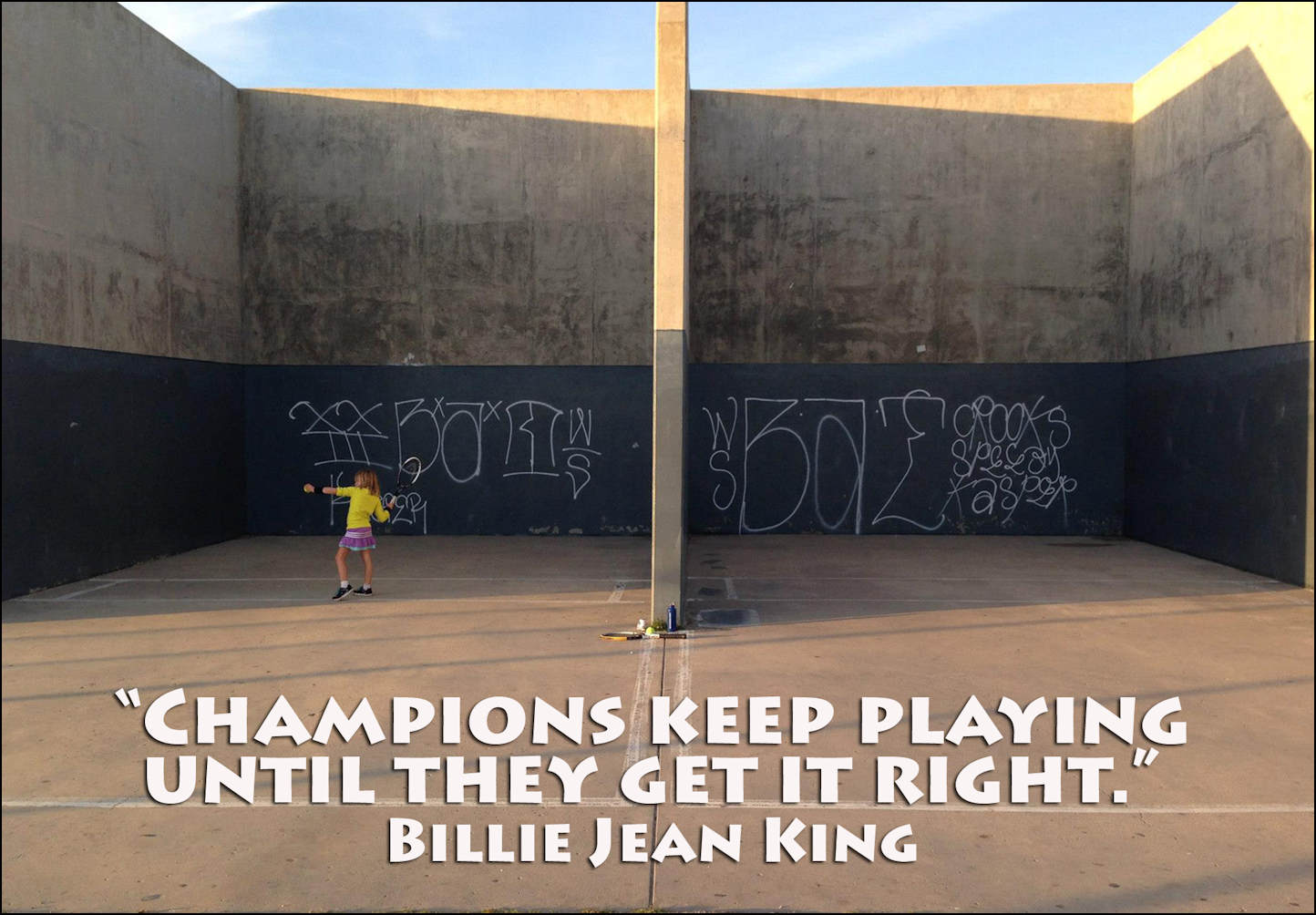
I was half horrified by that photo, because of all the graffiti from a local gang on the wall, and half amused by the juxtaposition of childhood innocence (my daughter) and street nastiness (the graffiti).
Below is a video from a decade ago of this same daughter and a family friend hitting tennis balls against the Wall:
But it has been many years since Julia has come with me. She claims, “It is boring, dad. Hitting against the Wall over and over.” Maybe.
But I don’t think it is boring.
Hitting a backhand perfectly. That is hard. Focusing on the footwork, the unit turn, getting the timing just right, hitting the ball in the “sweet spot” of the strings, swinging cleanly through the ball and extending out, then bouncing back into position afterwards. Can you put the tennis ball EXACTLY where you want it? Is your technique solid? It might look easy to hit a tennis ball correctly. But it is difficult. Practice it again and again. Maybe 40 minutes at the wall total. That should be enough.
I always leave the Wall feeling calmer and more grounded than when I arrived. My head is clearer. I can feel the tennis ball on the strings, and my legs and arms are ready to move in conjunction. I feel ready to compete at the highest level I can in my match the next day. I have done my homework. I am ready.
But show me that guy who has not hit a tennis ball in five days and he just saunters onto the court for an important match expecting to play his best? Not gonna happen. The brain and the body are not ready. He is not grooved; his technique is rusty, even if just a little. So he will make unforced errors. His tennis game will not be as it should. I will probably beat him. The famous 20th century pianist Vladimir Horowitz claimed, “If I don’t practice for one day, I notice; if I don’t practice for two days, my wife notices; if I don’t practice for three days, the audience notices.” I subscribe to Horowitz’s work ethic and disciplined desire for perfection, or the pursuit of perfection. It results in rigorous and intentional training on almost a daily basis.
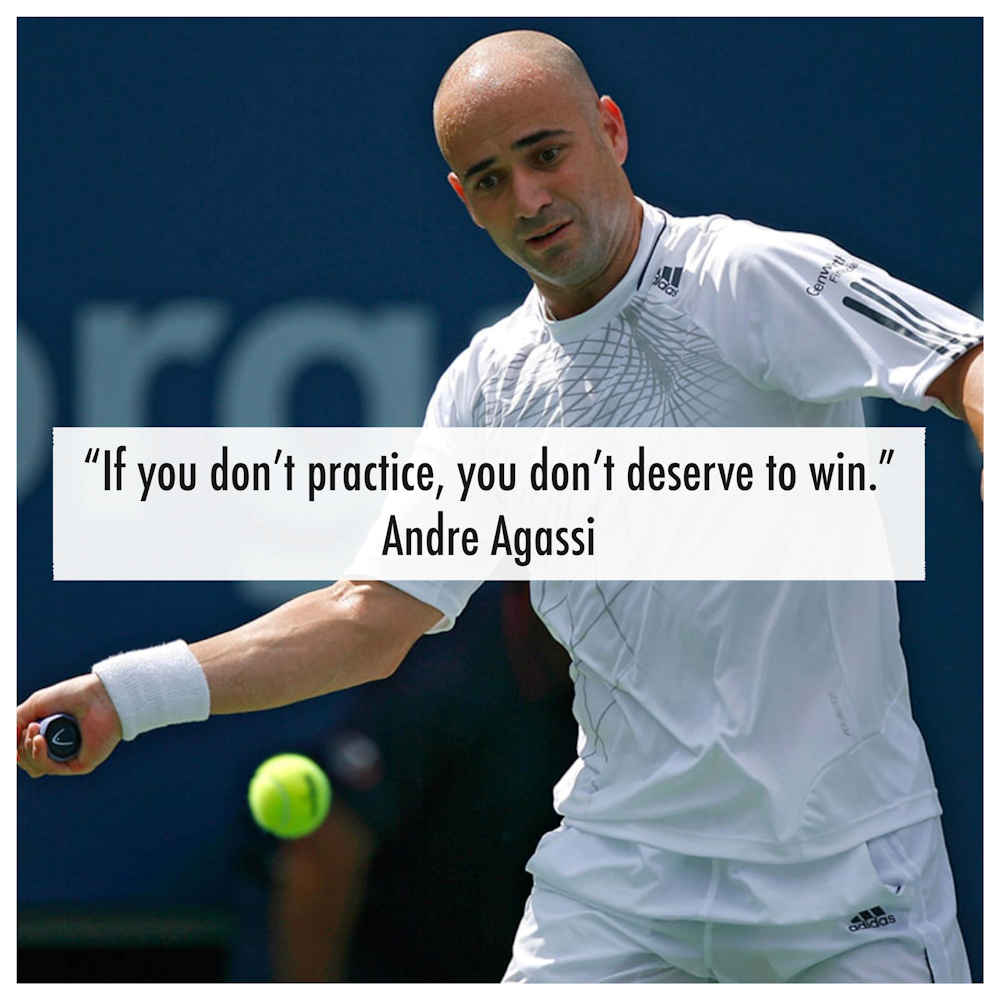
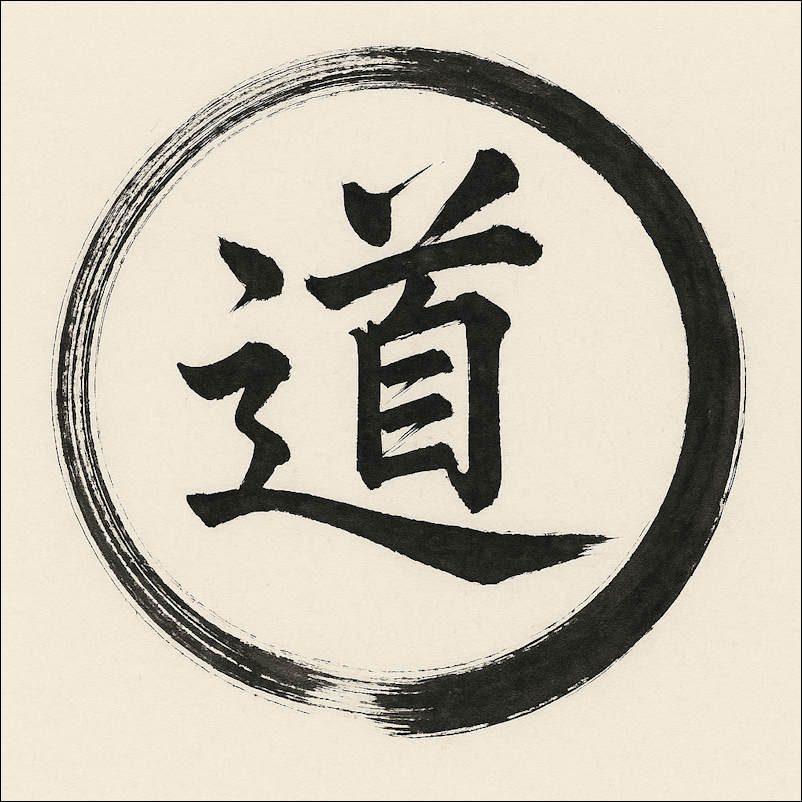
This, then, is a way of life — the Dao.
But it starts with the fundamentals, always the fundamentals.
Discipline, discipline. Focus. Then execution.
Your brain should almost move into a trance where your body cannot fail to make the correct movement. Again, it is meditation in motion. Body and mind are one, your limbs move as they should, and the technique is perfect – or at least as perfect as you can make it, after many decades of dedicated practice –
If you want to be the best you can be.
If you want to maximize your potential in an endeavor.
I don’t claim to be a tennis prodigy, or anything more than a solid amateur player. On any certain day I might play well and win – or encounter a better player and lose. That is sport.
But I have made a serious study of it. I have done all I can to learn from the best and maximize my potential on the tennis court, and off.
Tennis is a metaphor for life, and it has concrete benefits far beyond a game hitting a ball with a racquet on a lined court.