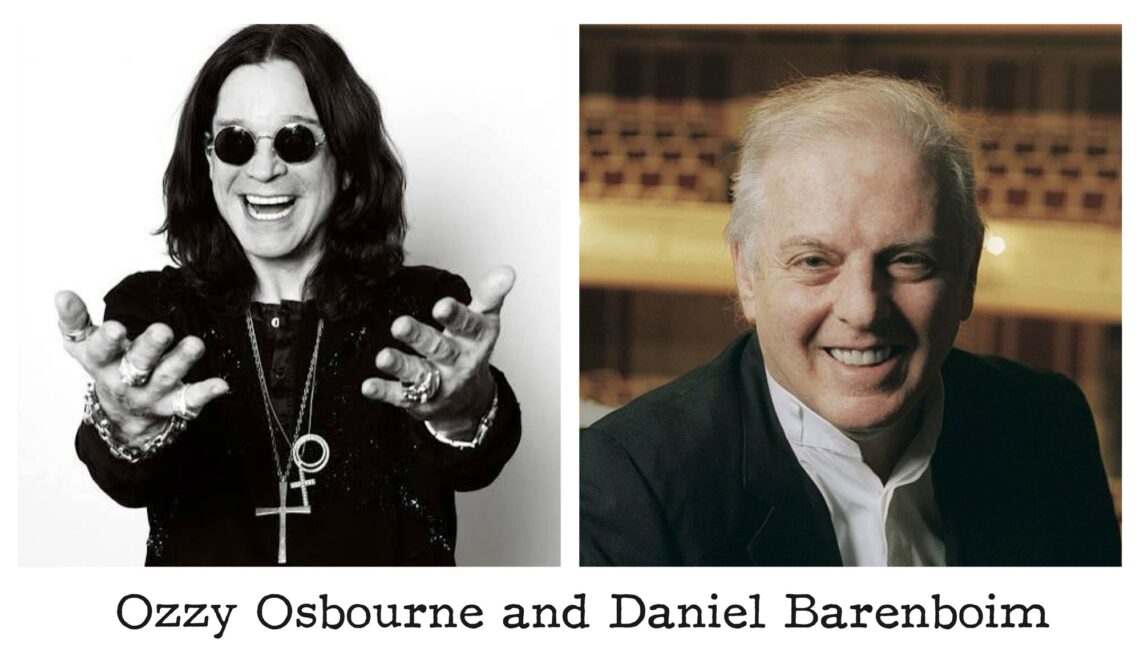
There are musicians, and then there are musicians. Ozzy Osbourne and Daniel Barenboim in the photo above, for example: they are both musicians but their training and careers could hardly be more different. The point of this essay will be to examine precisely how they are different, and how they are similar.
The life of a professional pianist in the classical music world demands the utmost discipline and commitment. Look at the below description which describes the training and life of a concert pianist as compared to a professional athlete:
That is intimidating, to put it mildly.
Then look at the van Halen brothers from the late 1970s and 1980s. In the heavy-metal hard-rock scene, Alex and Eddie van Halen were rumored to be more formally trained than most of their contemporaries. Their father was a professional musician from the Netherlands, and they supposedly imbibed the musical culture of old Europe with their mother’s milk. They were supposedly working with more than their own intuition on what “sounds good.”
But I read Alex’s autobiography last summer, and so I know more about this now. Both brothers had some piano instruction and the beginnings of musical theory, but neither could read music much. They did not progress far in that realm. But they did have extensive experience in what it meant to be a working musician in front of live audiences, partially shown to them by their father and also from their own experience. The two brothers were trying to earn success for their rock roll band from early adolescence onwards, and by 21-years of age they had already spent a good chunk of their time and energy working tirelessly towards that goal. If they did not know anywhere near as much music theory as a classical pianist, they definitely spent more time in front of live audiences. And a few years after that the van Halen brothers had much more experience in terms of working with record companies and managing money and marketing than a distinguished classical pianist of the same age. Eddie and Alex van Halen learned those lessons the hard way.
And after having read Alex van Halen’s book, I was also convinced that few wannabe rock stars in 1981 were going to emerge from the world of heavy metal music free from drugs and drug abuse, or women and sexually transmitted diseases. (The classical pianists not so much.) “Sex, drugs, and rock and roll!” Live intensely and recklessly, and all too often die young! (Classical pianists, on the other hand, are much more stable and enjoy longer careers.)
Take the recently deceased rock and roll singer Ozzy Osbourne. He emerged into the hard rock scene in the 1970s and made a name for himself with outrageous behavior. Osbourne himself claimed that, despite whatever music success he might have enjoyed, he would always be remembered “as the guy who bit the head off of a bat during a live concert.” That anecdote illustrates well the dual nature of rock and roll success: the music and the message is one thing, but the notoriety and marketing is another – maybe even more important. Ozzy spent many years recording his band’s music and touring in front of live audiences both by himself and with Black Sabbath. But I doubt he knew how to read music. His musical education was practical, not theoretical. Ozzy was pretty much done with original music by the early 1990s, when he was in his mid-40. By then he had made enormous amounts of money and was vastly famous.
In contrast, most professional classical pianists don’t make much money. Only a few become famous, or make any real money. They spend long years of study in youth learning to play piano; they often have famously demanding teachers. They learn immense amounts of music theory. Unlike rock stars, classical pianists can pursue careers well into the 70s or 80s. Rock stars don’t generally age well at work, as everyone has seen. That is a young person’s game. Rock stars burn brightly and exhaust themselves, generally. Classical musicians are more regular and long-lasting.
So the two are so different that a classical pianist and pop musician are hard to compare. But there are similarities. Lang Lang effuses at the piano, and audiences seem to like his emotionalism. Yuja Wang is beautiful and wears skimpy dresses while seated at the piano, and sex appeal is part of her brand; that is a different look from almost all other concert pianists previously. It helps her to stand out in the world of classical pianists. Lang and Wang are trying to make their own marketing niche in the world of classical music – to differentiate themselves, garner attention, build a following, and make money. In both worlds there are scores of musicians trying to “make it” and earn fame and wealth, and only a small number of them will achieve this.
But I have to admit this: the amount of study and learning a classical pianist puts into their career puts most pop stars nowadays to shame.
If you value unyielding discipline, formal learning, and absorbing tradition, then classical pianists are way more highly trained. But if you want to look at unique originality, raw creativity, and marketing skill, pop music superstars might come out ahead.
Ozzy Osbourne, Travis Scott, Paul McCartney, Miley Cyrus, and Madonna are examples of the latter. Martha Argerich, Isata Kanneh-Mason, Mitsuko Uchida, Vladimir Horowitz, and Seong-Jin Cho are examples of the former.
Pop music stars emerge onto the scene and ascend the charts to become household names and become richer than Croesus. Talented and ambitious classical pianists win the Cliburn Competition and mostly languish in relative obscurity. The marketing and the money at play are different in these two different musical worlds, as are the training and prerequisites.
I can enjoy both genres of music, depending on the artist involved. Neither is competing with the other: those music industries travel different paths which do not often cross. But by nature I generally respect classical pianists more than the contemporary popular musicians in the worlds of rap, rock and roll, or pop music. Because the classical musicians have usually studied so much harder to get to where they are, and they have a larger store of professional training and musical knowledge.
If the stars are aligned right and the moment is propitious, almost anyone can become a rock star (i.e. Ozzy Osbourne, Tommy Lee; Kurt Cobain, his wife). Not so with a classical pianist. The only road towards that end is incessant study and practice. Nobody is born an accomplished classical pianist. It is earned through discipline. Regard again these facts:
See what I mean?
Then look at the musical upbringing of Ozzy Osbourne. (Could Ozzy read music? Cobain?)
Two very different worlds, to be sure. Sure there are some which they share in common, but mostly they are different industries with distinct paths to success – and a very different definition of “success.” Classical pianists can earn a living, but very few make a lot of money – especially compared to pop music stars or even successful jazz musicians. It is a rarified specialty whose dedication and training I respect immensely.
Show me someone at the Grammys or American Music Awards. Whatever. Maybe they know what they are doing – that they have spent most of their life focused on music and making music – and maybe they are some 19-year old with a TikTok channel. But with the professional classical pianist you can be sure they have put in the “hard yards” since early childhood all the way to today. They are in it for the long haul. Most of them perform publicly until “arthritis or dementia” ends a career, and they are always expected to be maturing and improving. They are the “real thing.” Classical pianists know what they are doing.
So, yes, there are musicians and then there are musicians.





One Comment
Ashwin Rebbapragada
Beautiful comparison and description of classical musicians and rock legends. I generally prepare classical music. I like classical music because of the various instruments involved, complex melodies, and deep scores. I do think there are some pop songs and rock songs that classical music fans can enjoy. Thanks for this discussion. I thought it was interesting and enlightening comparing different genres of music.