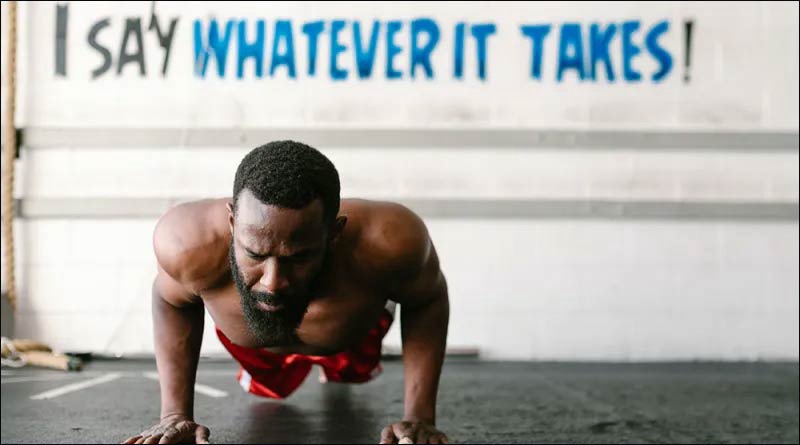
I recently read that weight lifting in the gym is the hot new trend, and along with that the American consumer’s desire to eat more protein: this is health nowadays, or so the trend says. Weight beating exercise using barbells is in; cardio on the treadmill or out running is out. There is supposedly a strong “lift only” culture which argues against cardio-dominant exercise.
This confused me. I asked a friend who was into this and she explained it to me thusly: “People have learned that endless cardio does not result in weight loss, and it can even harm more than hurt you. Cardio breaks you down. On the other hand, getting stronger in the gym with weights protects against osteoporosis and is the better way to go to be healthy. And weightlifting and everyday walking gives you sufficient cardio, anyways.”
I have no argument about weight lifting helping to preserve and increase functional strength, in addition to supporting bone density among the aging. But cardio-specific exercise is not helping you, also?
As an article summed it up:
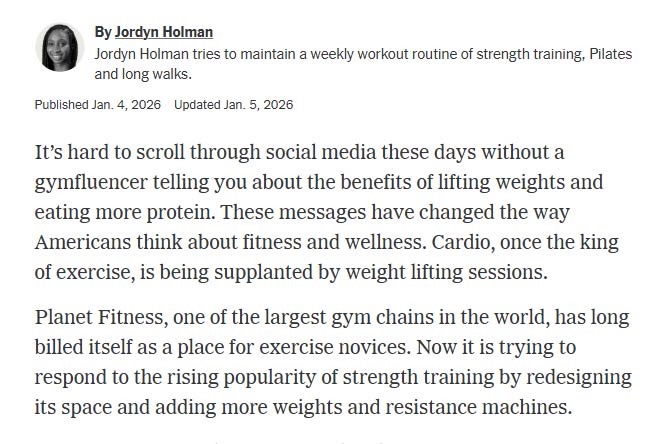
I think the problem here is the “gymfluencer” phenomenon. One exercise among many is being held up as the “better” one. “Cardio kills gains,” they claim, “and lifting is enough for heart health.”
I watch people I love and respect spend hours watching Andrew Huberman’s exercise podcast, and I scratch my head. Others go down YouTube or TikTok rabbit holes about “biohacks” for longevity, or follow online anti-aging advocates, maximal supplementation, or all-carnivore diets. I have friends who spend enormous amounts of time researching abstruse scientific principles in online disquisitions about health. There is this “influencer” suggesting you should do this, and another claiming the opposite. There is almost too much information. Then the online invective between these different camps can be intense. This is how you end up with an anti-cardio movement. The exercise ecosystem online is like the Wild West.
And here’s the real crux of the problem: too much time sitting while watching social media, and too little time sweating in the gym in real life.
I’ve always thought of gym work as what keeps you strong. It builds functional strength that carries over into daily life and helps you perform on the playing field. It engages the sympathetic nervous system – adrenaline, intensity, readiness – and that’s all to the good. Cardio, by contrast, strengthens the heart, lungs, and circulatory system. It tends to engage the parasympathetic nervous system – endorphins, rhythm, and recovery – and that’s equally valuable. They are two sides of the same coin. You need both.
This is what I always thought: Strength training keeps you capable. Cardio keeps you alive. You really want me to believe the former is more important than the latter?
You want BOTH. This seems so self-evident you should not need to say it.
For my tennis game, aerobic and anaerobic training are both important. I can distinctly feel the benefits of each.
But “gymfluencers” have weighed in; American exercise has changed as a result. Weight lifting is trendy. Protein and creatine are flying off the shelves. The gyms are crowded.
I see it in other domains too.
Online “flame wars” around these faux dilemmas:
In handguns: “9mm or .45?”
In the unarmed combat world: “Mixed martial arts or traditional martial arts?”
In youth social media related political debate there is this chestnut: “Charlie Kirk preparing to debate Hasan Piker!”
But let me start with the first example: Does it matter if you carry a firearm chambered in 9mm or .45? If you are interested in being a “responsibly armed citizen,” it mostly matters that you have a gun. The one caliber or the other is a relatively marginal discussion, in my opinion. But it has been amped up beyond belief by fiery back-and-forths in overwrought social media channels. Truly “the enemy of the good is the perfect.” A large-ish .357 round works for self-defense, as does a small-ish .380. Even a .22, while not ideal for armed combat, is way better than nothing. First rule of gun fighting: bring a gun to the fight. If that is non-negotiable, everything else is negotiable.
Why are so many so worked up about this? Is this war of words online a good use of time and energy?
How about in unarmed combat? Which is the best fighting system? Tae Kwon Do? Jiu Jitsu? Thai Boxing? MMA? Wing Chun Kung Fu? Krav Maga? Shotokan Karate? Is one any better than the other? There are pros and cons to all of them. But I think the best answer is this: just get off your couch and do any one of them.
That is the real problem, I think:
Contemporary Americans are glued to the screens of their smartphones. They are devouring endless hours of podcasts where “experts” are weighing in on this subject or that. The owners of social media companies have made themselves billionaires by creating algorithms which take you into the heart of these intractable imbroglios about this or that topic, and before you know it you have spent hours consuming videos on the subject. And then you have spent much more time watching media about the subject than you have at getting better at it.
“Stop watching ‘gymfluencers’ and get to the gym!” is what I say. Learn just enough about the aerobic and anaerobic exercise to see both are important and not at odds with each other. Then spend most of your time actually doing them. Get off the couch where you are sitting there looking and listening to your phone. Get outside and be active, move your body, and burn calories. Stop watching Andew Huberman, Joe Rogan, or (God forbid) someone like Andrew Tate.
There is too much online argumentation. Too many words, not enough sweat. Too much multimedia, not enough exercise. Too much “bed rotting” while staring at your smartphone, not enough action out in the world. The Internet can be a boon in a thousand different ways, but it can also do more harm than good in practice.
So: what do you think about 9mm versus .45 as a handgun cartridge, Richard?
My answer: yes.
Carry a gun. 9mm or .45 is not so important. Train with whatever gun you have. Know what you are doing.
Next: weight-lifting or cardio exercise?
My answer: yes.
Exercise. Do a little cardio and non-cardio, and more if you can. Turn off your smartphone, get off your couch, and do something active. “Motion is lotion” for aching joints, especially as you age, and “rest is rust.” Move your body, sweat in profusion, and burn calories. Build an appetite for your next meal by working out, and earn your good night’s sleep for that night. How you exercise seems less important to me than the fact that you exercise. First things first.
Because sitting there inactive while staring at your phone is the enemy. That is the malady which afflicts too many in America today. “Gymfluencers” are the enemy. “Armchair warriors” engaging in “flame wars” on Instagram are a distraction, keeping you looking into your phone and preventing you from taking concrete action to be more physically active. What is a major debate online is not necessarily a big problem in real life. Having an active online life in the artificial ether of the Internet is not the same as having a vibrant healthy life out in the real world. That is where it really counts.
On the one hand: There are enormous amounts of high quality information on the Internet which can help you. Before the Internet you might have had to search high and low to find this information. Now it is free online – if you can discern between the wheat and the chaff, which is not easy to do.
However: We are plagued by gymfluencers, podcasters, and other assorted online voices. They are seeking to monetize your attention and make a comfortable living for themselves. Their advice might be valuable, or it might not. You might not have the background knowledge to sift between what is true and what is not. You might find it easier to view TikTok videos about working out rather than to actually work out. That seems where society is heading. This is the problem, in my opinion.
So is the “Zone-2 cardio” Andrew Huberman promoting an idea which is a sort of magic which will maximize your exercise results? No. Is it worth spending an hour learning about? Maybe. As long as you actually take action to do any sort of cardio at all. The move to actually work out and sweat is much harder than to sit there and listen to another streaming video online. The minute differences between Zone 2 and Zone 1 and Zone whatever? You can probably intuit it all yourself. Someone in 1975 or 1995 could figure this out themselves. Or a personal trainer in real life could handle this all more quickly and efficiently face-to-face. They could personalize the advice to the individual person.
So down with the Tik Tok and Instagram “gymfluencers” – and online “influencers” in general! There is the germ of a good idea or helpful insight in exercise which is then oversimplified and monetized, and then it is all absolutized into a rigid policy which can create serious harm. You have this guy on YouTube who knows nothing about you, and he is telling you exactly how to exercise without regard to your age, health, or personal limitations.
There is still common sense advice: Get a modicum of good exercise, eat healthy most of the time, severely restrict the booze and cigarettes, get close to 8 hours of sleep per night, and keep your friends and family close. Work on those basics. Get a good blend of cardio and weight bearing exercise; any such exercise is better than none, and more is better than less. You can work out too much, for sure, but most people don’t and consistency is important. And in the process avoid online “experts” who want to explain it all way beyond what is necessary. It is a trap designed via social media to steal your time and energy in an “attention economy” whereby tech titans and downstream hucksters and grifters seek to make money off you. Your time and attention is what they want. Don’t give it to them.
Be advised.
“Gymfluencers.”
Jeez.
Thank you for listening to my rant.