
It must have been sometime during the summer of 2017.
I was driving south on the 5 Freeway through Camp Pendleton on my way to San Diego to visit a college friend I had not seen for years. I remember it was during the summer. Beyond that the exact details are blurry.
But I remember the emotions of that moment clearly.
“Trudy has cancer again. It is mostly in the breast tissue. But the scans show it has also spread to the hip bone, spine, and the liver.” My dad delivered this information to me about his wife, my step-mother, Trudy Rideout. This was not her first bout with cancer. It would be her last.
I was devastated. The news hit me hard.
This was the second time I had received such a phone call from my dad. The first time was in fall of 1995 when he informed me that doctors had discovered a tumor the size of a softball in my mother’s lung. It was Stage-4 “adenocarcinoma” lung cancer. A quick visit in the pre-Internet era to a Barnes and Nobles bookstore to consult a medical journal was all it took for me to see it was a death sentence. I had no illusions. My mother was gone 14 months later. No amount of gloss was going to brighten the ugly facts at play. I didn’t even try.
Now my step-mother had metastatic cancer. The future did not look good. Trudy Rideout lasted longer than did my mother, as a beneficiary of much improved cancer treatment in 2017 versus 1996. But she did not last. She finally succumbed to cancer in October of 2020. My mom refused medical treatment towards the end and went quickly. My stepmom fought with everything she had until the very end without much result.
What do I remember about hearing that horrible news in my car on the freeway down to San Diego? What is emotionally resonant years later?
I remember the song. Or I remember the two songs I associate with that first day, as well as the following months and years, of my stepmother dying.
The first is “Spiegel im Spiegel” by Arvo Pärt. I had been hugely affected by the 2001 motion picture “Wit” directed by Mike Nichols based on the 1999 Pulitzer Prize-winning play of the same title by Margaret Edson. The film skillfully and insightfully portrays the initial diagnosis, physical decline, and eventual death of an English literature professor from advanced ovarian cancer. They used the “Spiegel im Spiegel” piece in the movie soundtrack, and so the sounds seem to have bonded to my brain with images of macerating to death by invidious cancer. So after my dad delivered the bad news to me about my stepmother, I immediately pulled up “Spiegel im Spiegel” and listened. In fact, I listened to it over and over. I traveled southbound on the 5 Freeway through the Marine Corps base with the Pacific Ocean to my right, stunned by the bad news which I was trying to process – I remember it clearly. I see it in my mind like it happened yesterday.
“Spiegel im Spiegel” is a minimalist piece of music, prone to encouraging deep thought on sickness, death, and loss – or at least it is that way for me. Funny how music, without any words, can become a metaphor for real life phenomenon. “Spiegel im Spiegel” will always for me bring to mind terminally ill patients in backless hospital gowns listening to doctors explaining blunt facts about their demise. It will never be anything else. The music is somber and meditative in the extreme. Perfect for my use. “Spiegel im Spiegel” is about mortality. At least for me.
I have seen a good deal of death in my life via several different contexts. Intellectually I have come to understand it. But emotionally I remain dumbfounded by death. “Spiegel im Spiegel” by Arvo Pärt brings that reality front and center again when I listen to it. I sit in silence and reflect. There are no words. Maybe death in the end is a thing beyond words. Perhaps music better expresses it. The sounds adopt the shape of metaphor. An emotion is communicated, a moment is encapsulated.
The second song is “E-centered Chorus” from Einstein on the Beach by Philip Glass. It is another piece of music driven by repetition and rhythmic pulse, and it takes me to a similar place as does “Spiegel im Spiegel.” I listened to “E-Chorus” often in the following years when Trudy Rideout was fighting for her life against cancer. “Death, thou are mighty and proud…” “Rage, rage against the dying of the light!” That is all true. But I have found there is also much silence, sadness, and stillness in dying. When the initial tears are all cried out and exhaustion sets in, a dying person tries to understand what is happening. They do that in silence and contemplation. Even surrounded by loving family and friends, everyone dies alone. It is a highly individual and situational thing. A person sits with the fact of their mortality and looks death in the face. It might be “sad,” but sad is much too pedestrian and unambitious a word to encompass the immensity and finality of death.
This is what “Spiegel im Spiegel” and “E-Chorus” symbolize for me.
I am driving down a California freeway in summertime when I receive the sudden news: a dear loved one will decline and die of cancer. It does not really matter what I think or feel about it. The clock is ticking, and death is at the door. So I will look out towards the ocean and meditate on the power of this blunt and brutal fact, and the inevitable and devastating blow it will bring to the lives of myself and my family.
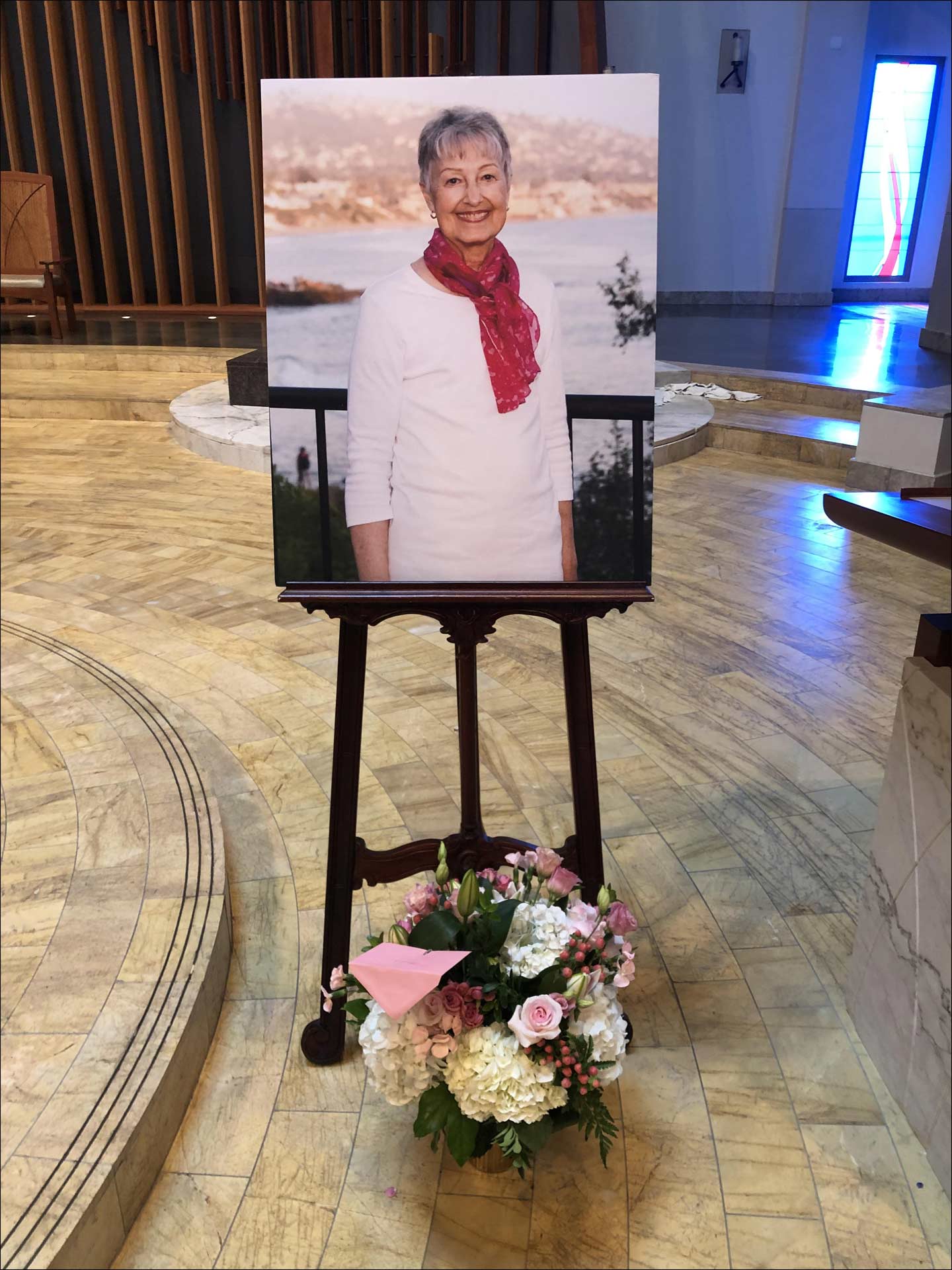
Rest In Peace, Trudy Rideout.





One Comment
Ashwin Rebbapragada
A very moving, touching, and thoughtful post. You have an incredible, loving, and amazing family. I am so sorry for your losses in life. Cancer is very painful. Music and art helps humans express emotions and feelings. Music captures our moods, thoughts, feelings, dreams, and hopes in a way that words cannot express. Music and art can bring healing, peace, and direction. Thank you for writing this post and the musical recommendations. Art inspires us in different ways and gives us peace in difficult times.